Home » First Aberrant-Coloured Shearwater Recorded in Madeira
First Aberrant-Coloured Shearwater Recorded in Madeira
A white shearwater off Calheta
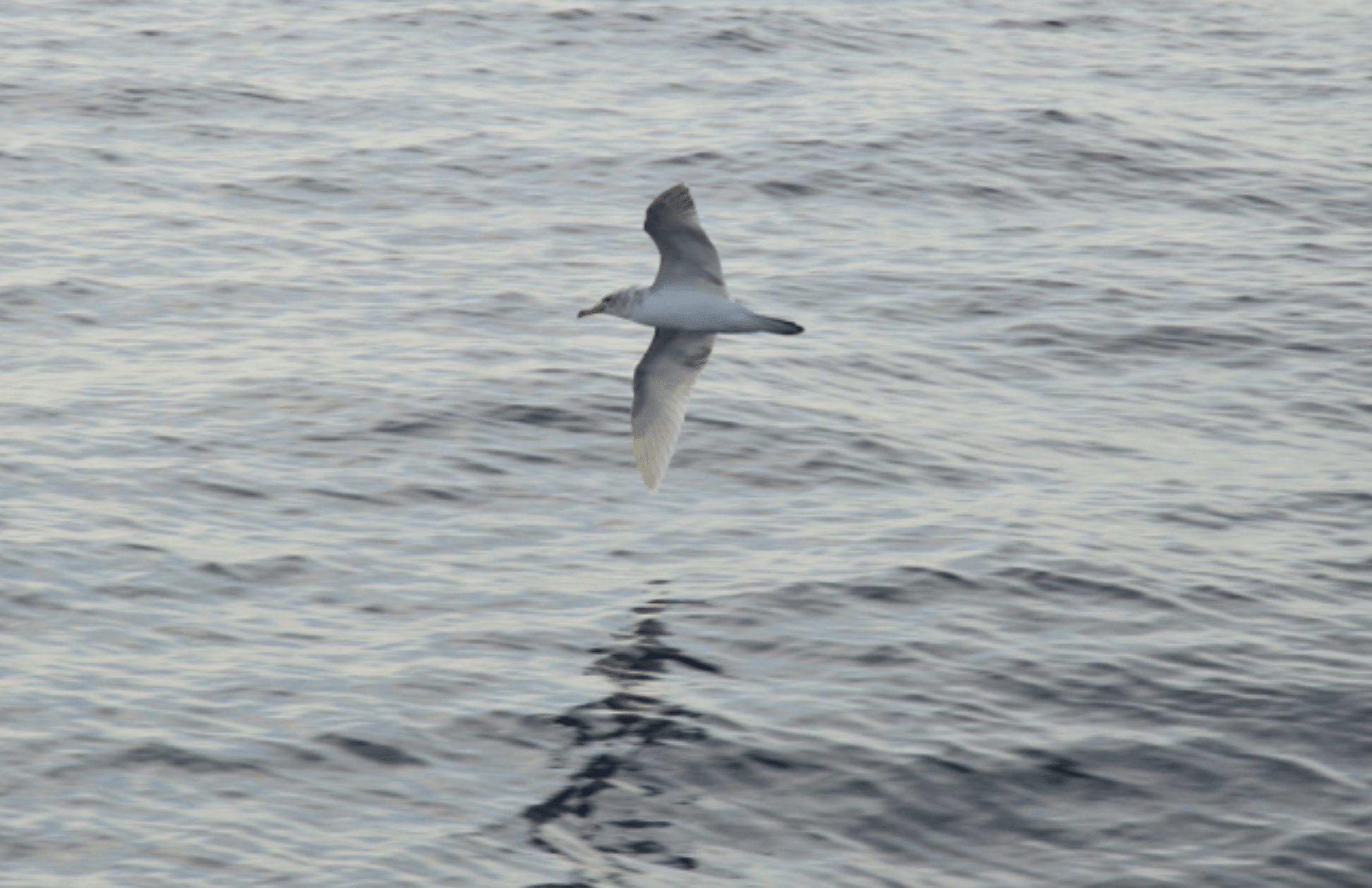
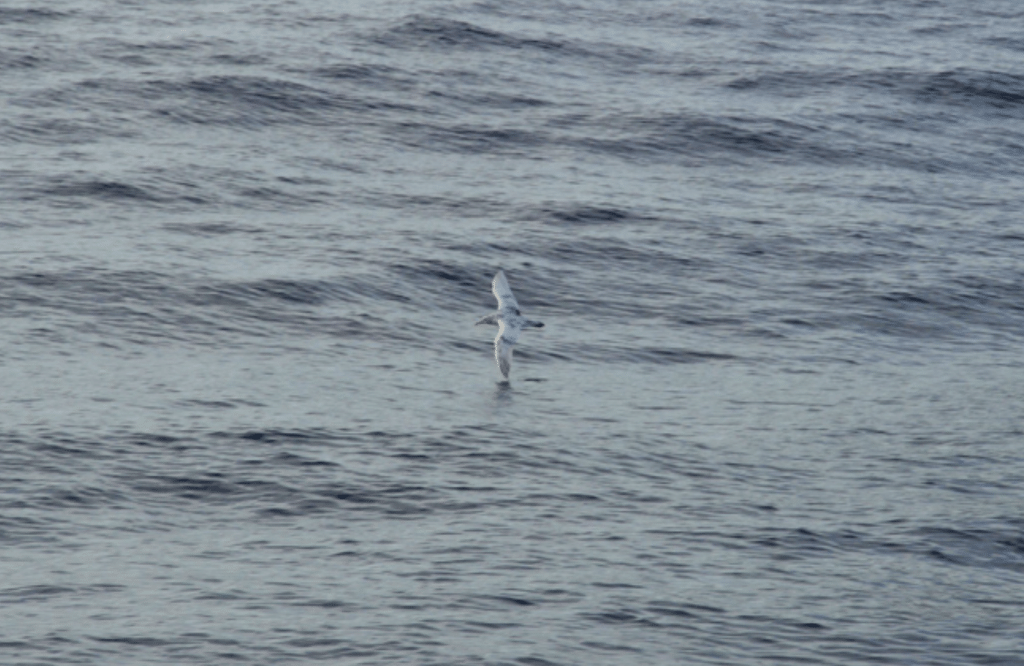
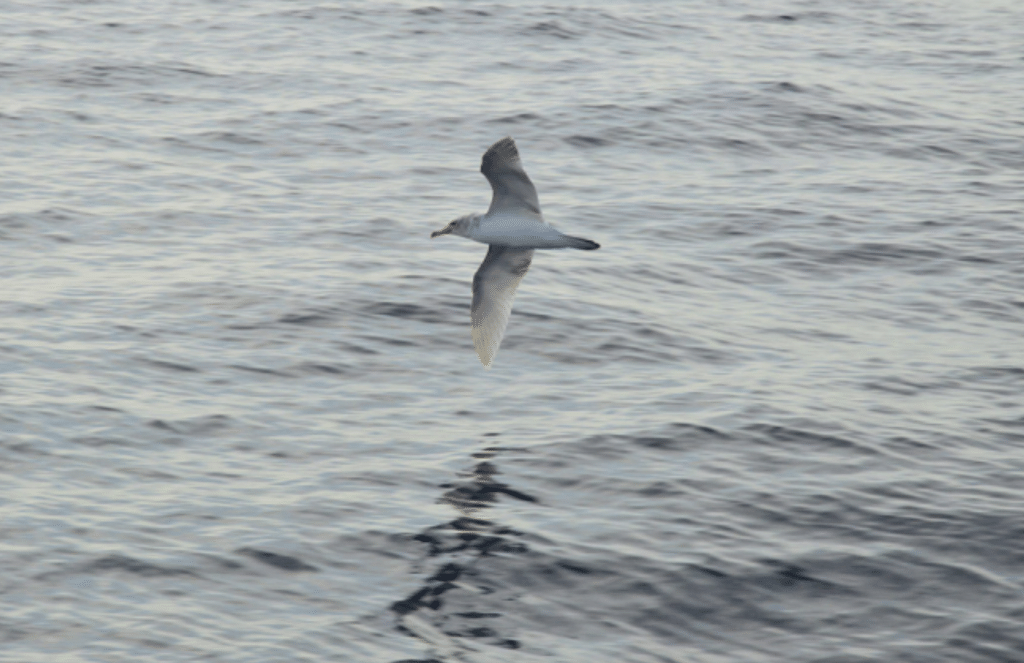
On 14 November 2023, our crew spotted a shearwater that looked almost completely white – the first aberrant-coloured Calonectris shearwater ever recorded in Madeira. The sighting was published in the peer-reviewed journal Marine Ornithology in 2025, written by the On Tales team: Pedro Nascimento, Emanuel Santos, João Gonçalves and Mayung Teixeira.
Cory’s shearwaters are among the most common seabirds you will see on our tours. Normally they are brown-grey above and white below. This bird had more white feathering than any shearwater of its genus reported anywhere so far.
Sighting at a glance
A nearly all-white shearwater off Calheta
First record in MadeiraPeer-reviewed · Marine Ornithology 2025
Species
Calonectris sp. – Cory’s or Scopoli’s shearwater
Date & time
14 November 2023, around 18:00
Location
About ⅓ nautical mile off Calheta, southwest Madeira
Spotted from
M/V Miranda, during an On Tales whale watching tour
Group
Flying with around 15 Cory’s shearwaters
Plumage
Mostly white above and below, grey-brown patches, entirely dark tail
Aberration
Not albinism, not leucism – possibly progressive greying (unconfirmed)
Why it matters
Most extensive white plumage ever reported for the genus
Authors
Pedro Nascimento, Emanuel Santos, João Gonçalves & Mayung Teixeira (On Tales)
The bird appeared at about 18:00 during a whale watching tour aboard our boat Miranda, around a third of a nautical mile off Calheta. It was flying with a loose group of about 15 Cory’s shearwaters.
Feature
What we saw
Size and shape
Typical for a Cory’s shearwater
Eyes and bill
Normal: dark eyes, yellowish bill with a blurred dark tip
Upperparts
Mostly white, with irregular grey-brown patches on the back, wings and upper-tail coverts
Head and nape
Mottled, light grey-brown to white
Tail
Entirely dark
Underparts
Almost entirely white, with dark patches on the flight feathers and underwing coverts
[Photo: Fig. 1 – upperparts. Photo: Pedro Nascimento, On Tales]
[Photo: Fig. 2 – underparts. Photo: Pedro Nascimento, On Tales]
Why this record matters
Colour aberrations are rare in Calonectris shearwaters: only four official published records existed before ours, and none from Madeira. The most recent, from the Azores in 2019, showed far fewer white feathers than our bird.
Published
Location
What was recorded
Source
2025
Calheta, Madeira
Most extensive white plumage reported for the genus
Nascimento et al. (2025) – this record
2019
São Miguel, Azores
One leucistic Cory’s shearwater
Al-Abbar et al. (2019)
2011
Chalkidiki, Greece
Aberrantly coloured bird, possibly non-genetic
Nikolov et al. (2011)
2005
Faial (Azores) and Gran Canaria
First two melanistic (dark) birds
Bried et al. (2005)
2004
Breeding colony near Crete
Two birds with “partial albinism”
Ristow & Witte (2004)
Older records were published before Cory’s and Scopoli’s shearwaters were split into two species, so they use the name C. diomedea for both. The highest rate found so far is leucism in 3.5% of 3,200 Scopoli’s shearwaters studied in Malta.
Every new record helps scientists understand how often these aberrations occur and what causes them – which is why we published ours.
Albino, leucistic – or something else?
We could not pin down the exact type of aberration, but we could rule two out.
Not albinism. An albino lacks melanin completely: all-white feathers and pale eyes, bill and legs. Our bird still had dark patches and normal dark eyes.
Not leucism. Leucism removes pigment symmetrically. Here the loss was uneven: the primaries on the left wing were much darker than those on the right.
Possibly progressive greying. This could explain the pattern, but we could not confirm it. So we cannot say the condition is inherited.
Cory’s or Scopoli’s shearwater?
We could not tell. November is migration season for both species, which look very similar. The best field mark to separate them is the underwing pattern – and that was exactly what the white plumage obscured. The bird is therefore recorded as Calonectris sp.
FAQ
Can I see Cory’s shearwaters on a whale watching tour in Madeira? Yes. Cory’s shearwaters breed in the Madeira archipelago and are seen on most tours from spring to autumn. Our crew regularly points them out alongside dolphins and whales.
What is the difference between albinism and leucism in birds? Albinism is a total lack of melanin, so feathers, eyes and skin are all pale. Leucism is a partial, usually symmetrical loss of pigment in the feathers, while eyes stay dark.
Was the white shearwater a Cory’s or a Scopoli’s shearwater? It could not be confirmed. The underwing pattern that separates the two species was hidden by the white plumage.
Where was the paper published? In Marine Ornithology, vol. 53, issue 1 (2025), pages 193–195. It is open access via doi.org/10.5038/2074-1235.53.1.1622.
Citation and licence
Nascimento, P., Santos, E., Gonçalves, J., & Teixeira, M. (2025). First aberrant coloured Calonectris shearwater recorded in Madeira, Portugal. Marine Ornithology, 53(1), 193–195. https://doi.org/10.5038/2074-1235.53.1.1622
This article is a summary of the paper above, published under a Creative Commons Attribution-ShareAlike licence.
References
Al-Abbar, F., Silva, M. S. C., & Geelhoed, S. C. (2019). Leucistic Cory’s Shearwater Calonectris borealis off São Miguel, Azores, in November 2019. Seabird, 32, 119–121. https://doi.org/10.61350/sbj.32.119
Bond, A. L., & Diamond, A. W. (2016). Aberrant colouration in the Atlantic Puffin (Fratercula arctica), the Common Murre (Uria aalge), and the Thick-billed Murre (U. lomvia) from Atlantic Canada. Canadian Field-Naturalist, 130(2), 140–145. https://doi.org/10.22621/cfn.v130i2.1837
Bried, J., Fraga, H., Calabuig-Miranda, P., & Neves, V. C. (2005). First two cases of melanism in Cory’s Shearwater Calonectris diomedea. Marine Ornithology, 33(1), 19–22. https://doi.org/10.5038/2074-1235.33.1.636
Ducatez, S., & Devore, J. L. (2023). Observation of a leucistic Brown Noddy Anous stolidus in Tetiaroa, French Polynesia. Marine Ornithology, 51(1), 23–25. https://doi.org/10.5038/2074-1235.51.1.1505
Flood, R. L., & Fisher, E. (2020). North Atlantic seabirds: Shearwaters, Jouanin’s & White-chinned Petrels. Scilly Pelagics – Pelagic Birds & Birding Multimedia ID Guides.
Flood, R. L., & Gutiérrez, R. (2021). Field separation of Cory’s Calonectris borealis and Scopoli’s C. diomedea Shearwaters by underwing pattern. Marine Ornithology, 49(2), 311–320. https://doi.org/10.5038/2074-1235.49.2.1438
Flood, R. L., & van Grouw, H. (2015). Unfamiliar plumage types of fulmars in the North Atlantic. British Birds, 108(6), 331–348.
Frainer, G., Daudt, N. W., & Carlos, C. J. (2015). Aberrantly plumaged White-chinned Petrels Procellaria aequinoctialis in the Brazilian waters, south-west Atlantic Ocean. Marine Biodiversity Records, 8, e103. https://doi.org/10.1017/S1755267215000871
Garrett, K. (1990). Leucistic Black-vented Shearwaters Puffinus opisthomelas in southern California. Western Birds, 21(2), 69–72.
Mancini, P. L., Jiménez, S., Neves, T., & Bugoni, L. (2010). Records of leucism in albatrosses and petrels (Procellariiformes) in the South Atlantic Ocean. Revista Brasileira de Ornitologia, 18(41), 245–248.
Ristow, D., & Witte, L. (2004). Partial albinistic cases in adult and juvenile Cory’s Shearwaters. Avocetta, 28(1), 31–32.
van Grouw, H. (2006). Not every white bird is an albino: Sense and nonsense about colour aberrations in birds. Dutch Birding, 28, 79–89.
van Grouw, H. (2013). What colour is that bird? The causes and recognition of common colour aberrations in birds. British Birds, 106, 17–29.
van Grouw, H., Russell, S., & Merne, O. J. (2011). Notes on colour aberrations in Common Guillemot Uria aalge and Northern Gannet Morus bassanus. Seabird, 24, 33–41. https://doi.org/10.61350/sbj.24.33