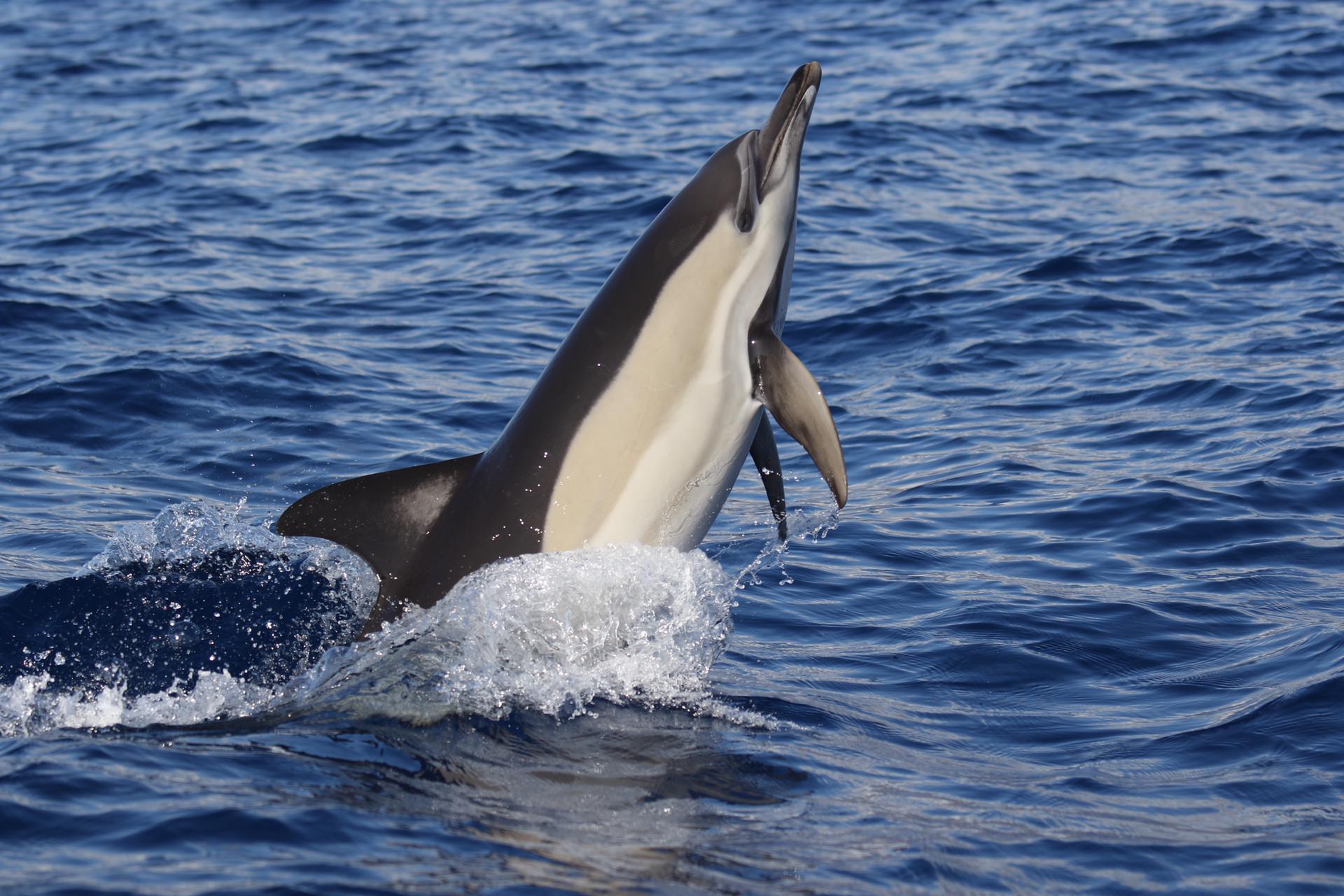
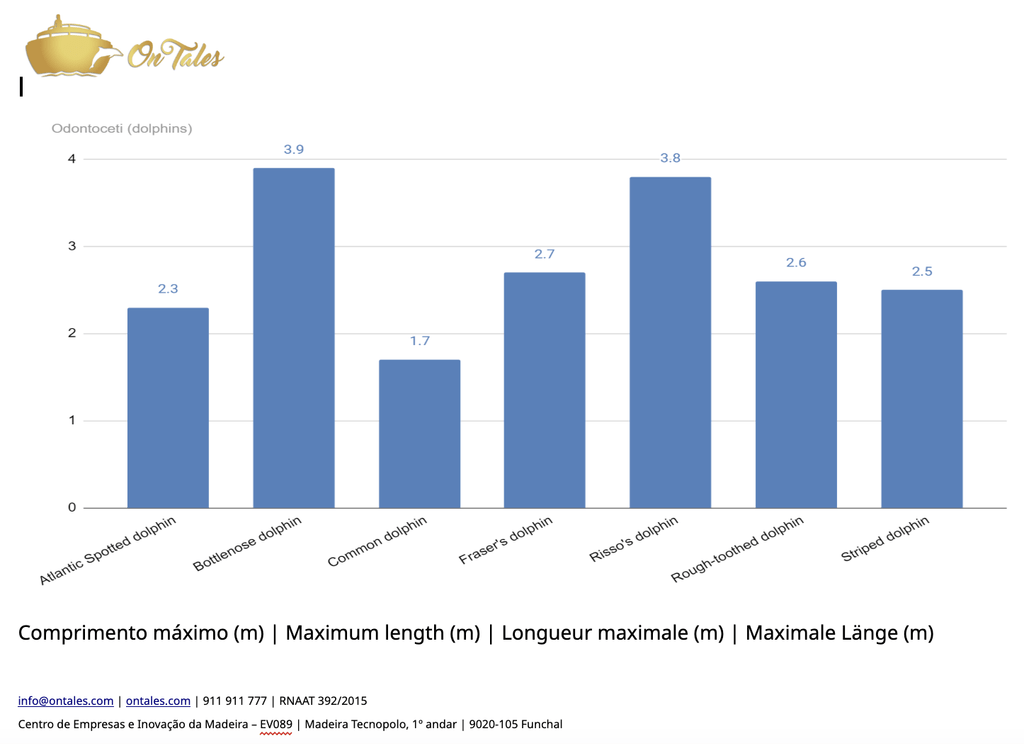
Among the dolphins sighted off Madeira, the bottlenose dolphin is the largest, reaching up to 3.9 metres, closely followed by Risso’s dolphin at 3.8 metres. The common dolphin is the smallest in this group, with a maximum length of just 1.7 metres. Compared to Odontoceti whales, all dolphins have modest dimensions, but the variation within the group is significant — the bottlenose dolphin is more than twice the size of the common dolphin.
Two size categories at sea
On a trip off Madeira, expect to see dolphins in two size categories. The large dolphins are the bottlenose dolphin and Risso’s dolphin, which reach up to 3.9 and 3.8 metres. All the others (Atlantic spotted, common, striped, rough-toothed and Fraser’s dolphin) are average-sized, with maximum lengths between 1.7 and 2.7 metres.
Chart Data Table
Species
Maximum length (m)
Atlantic spotted dolphin
2.3
Bottlenose dolphin
3.9
Common dolphin
1.7
Fraser’s dolphin
2.7
Risso’s dolphin
3.8
Rough-toothed dolphin
2.6
Striped dolphin
2.5
References (with hyperlinked sources)
Silva, M. A., Chevallard, P., & Pérez-Jorge, S. (2022). Atlantic Spotted Dolphin Stenella frontalis. In Handbook of the Mammals of Europe. Springer International Publishing. (no public DOI/URL found)
Perrin, W. F. (2009). Atlantic spotted dolphin: Stenella frontalis. In Encyclopedia of Marine Mammals (pp. 54–56). Academic Press. (no public DOI/URL found)
Barratclough, A. et al. (2023). How to estimate age of old bottlenose dolphins (Tursiops truncatus). Frontiers in Marine Science, 10. https://doi.org/10.3389/fmars.2023.1135521
Kerem, D. (2026). Rough-Toothed Dolphin Steno bredanensis (Lesson, 1828). In: Hackländer, K., Zachos, F.E. (eds) Handbook of the Mammals of Europe. Springer, Cham. https://doi.org/10.1007/978-3-319-65038-8_104-3
Roca-Monge, K. et al. (2022). Age and Sexual Maturity Estimation of Stranded Striped Dolphins. Oceans, 3, 494–508. https://doi.org/10.3390/oceans3040033
MBM (2021). Fichas de identificação de cetáceos no Arquipélago da Madeira. 66p. (no public URL — recurring, per tracker)
Freitas, L., Dinis, A., Alves, F., Nóbrega, F. (2004). Cetáceos No Arquipélago Da Madeira. Museu da Baleia, Funchal. (no public URL — recurring, per tracker)