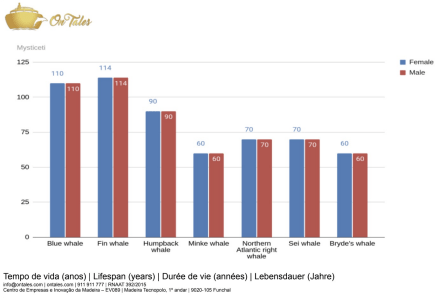
Mysticeti are among the longest-lived animals on the planet. The fin whale leads with up to 114 years in both sexes, followed by the blue whale at 110 years. Unlike Odontoceti, where females tend to live longer, in Mysticeti sex parity is very pronounced — most species record identical values for males and females. Bryde’s whale and the minke whale have the shortest lifespans in the group, with 60 years for males.
Blue whale: Roston, R. A., Lickorish, D., & Buchholtz, E. A. (2013). Anatomy and age estimation of an early blue whale fetus. Anat Rec 296: 709–722. https://doi.org/10.1002/ar.22678
Fin whale: Lockyer, C. (1972). The age at sexual maturity of the southern fin whale. Journal Du Conseil, 34, 276–294. doi:10.1093/icesjms/34.2.276 https://doi.org/10.1093/icesjms/34.2.276
Humpback whale: Clapham, P. J. (1992). Age at attainment of sexual maturity of humpback whales. Can J Zool 70: 1470–1472. doi:10.1139/z92-202 https://doi.org/10.1139/z92-202
Humpback whale: Polanowski, A. M. et al. (2014). Epigenetic estimation of age in humpback whales. Mol. Ecol. Resources 14, 976–987. https://doi.org/10.1111/1755-0998.12247
N. Atlantic right whale: Hamilton, P. K. et al. (1998). Age structure and longevity in North Atlantic right whales. Marine Ecology Progress Series, 171, 285–292. https://doi.org/10.3354/meps171285
N. Atlantic right whale: Fortune, S. M. E. et al. (2021). Body growth of North Atlantic right whales revisited. Mar Mamm Sci 37: 433–447. https://doi.org/10.1111/mms.12753