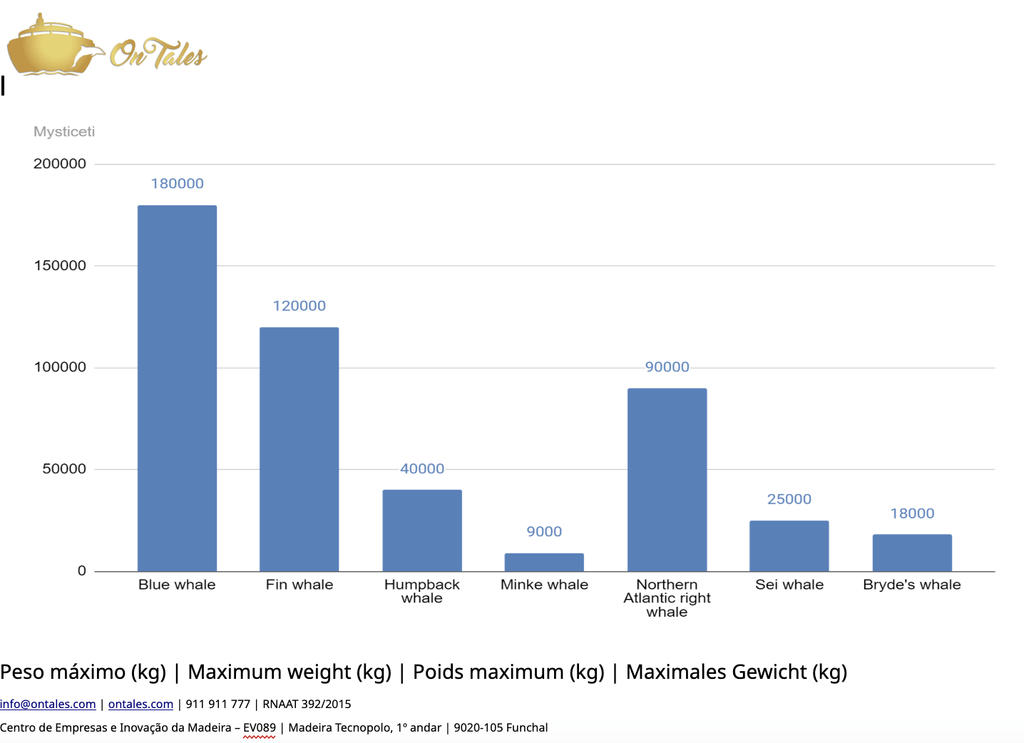
Mysticeti include the largest animals ever known to exist on Earth. The blue whale is the largest living creature, reaching up to 180,000 kg — 20 times the weight of a humpback whale and 10 times the largest sperm whale. The fin whale follows at 120,000 kg. At the other extreme, the minke whale weighs only 9,000 kg, making it the smallest of the great baleen whales. The size diversity in this group reflects adaptations to different feeding strategies and oceanic habitats.
Balaenoptera musculus (Linnaeus, 1758) in Döring M (2022). English Wikipedia – Species Pages. Wikimedia Foundation. https://doi.org/10.15468/c3kkgh
Roston, R. A., Lickorish, D., & Buchholtz, E. A. (2013). Anatomy and age estimation of an early blue whale fetus. Anat Rec 296: 709–722. https://doi.org/10.1002/ar.22678
Weinrich, M. T., Schilling, M. R. & Belt, C. R. (1992). Evidence for acquisition of a novel feeding behaviour: lobtail feeding in humpback whales. Animal Behaviour 44: 1059–72. https://doi.org/10.1016/S0003-3472(05)80318-5
Kitayama, C. et al. (2015). Structure and functions of the placenta in common minke, Bryde’s and sei whales. Journal of Reproduction and Development 61: 415–421. https://doi.org/10.1262/jrd.2015-005
Fortune, S. M. E. et al. (2021). Body growth of North Atlantic right whales revisited. Mar Mamm Sci 37: 433–447. https://doi.org/10.1111/mms.12753
MBM (2021). Fichas de identificação de cetáceos no Arquipélago da Madeira. 66p. (no online source found — institutional publication)
Freitas, L., Dinis, A., Alves, F., Nóbrega, F. (2004). Cetáceos No Arquipélago Da Madeira. Museu da Baleia, Funchal. (no online source found — institutional publication)